Thursday, March 5, 2015

Tucson Treasures, Part Three

I am really grateful to have the time to reflect on all that I did, saw and learned in Tucson.  We are spending the week with our friends Marilyn and Dale in Desert Edge, California.  I think that everyone at Healing Waters Park, where they live, who sees me working away every morning on my laptop probably wonder what that woman is working on that keeps her away from the desert.  It is lovely at the end of my work to take a break and enjoy the area.  This morning I am working outside and hummingbirds are visiting me on their way to and from the orange tree that is in blossom.  The smell of the orange blossoms is so sweet that I am lulled into a sense of peace and well being.  Mike has been hiking, biking and enjoying life in the desert while I work.  I think it has been a good trip for him and he is taking full advantage of having his bike on the trip.  He has been riding a 31 mile loop up and down hills and is quite happy to be warm!

Orange blossom
Baby hummers


So, back to reflecting on Tucson.  The day after I visited with Anna and her class on migration, I drive into town to interview Emrys Staton in depth. I met him at the Borderlinks facility where he is a board member and where I had originally met him during our Immigration Justice experience.  Emrys is an social justice activist, theology student and a person with a great deal of integrity who grew up in Arizona.  He came to Tucson from Northern Arizona and was raised as a Unitarian Universalist.  He was exposed to the concepts of suffering and political engagement as a means to alleviate suffering as a child, both through his religious education and by the examples set by his politically involved parents.  It seems to have stuck with him.  He majored in geography with an emphasis on social justice at the University of Arizona.  He told me that he was a sophomore in college on September 11, 2001.  He reported alot of hate being present on campus immediately following the attacks.  He joined Beyond Tolerance, a campus group formed to help mitigate the climate of hate.  His journey towards the activism he now engages in continued by befriending a group of Sudanese refugees who had been settled in Tucson by the UN High Commission on Refugees to attend the university.  He learned from them what it personally meant to be a refugee.  These young men had left their homes at the ages of 9 and 10 to travel safety and it took years of struggle and horrible treatment to arrive in Tucson.  Emrys was horrified by the stories they told.
Emrys
By the end of college he was working in independent media on food and justice issues and would attend protests and actions and be beaten up and then report the experience. This preceded the blog and other social media era.  It was the only way to get the truth out about how demonstrators were being treated.

Emrys became in involved in No More Deaths(NMD) from the beginning.  He attended the inaugural event, a Memorial Day 2004 cross border march between Nogales Arizona, and Nogales, Sonora.  He went first as an independent/citizen news reporter and later as a core member of the organization.  A year later he was fully involved and living with a group of activists who were all dedicated to NMD. He spent time at the first encampment NMD in the desert in the summer months of 2004. The encampment provides first aid, water and respite for migrants crossing the desert in the hottest months of the year.  It still operates and is now sanctioned by the International Red Cross which makes it a little safer than some other humanitarian operations from being raided by law enforcement and anti-immigrant vigilantes.  

I asked Emrys what victories he has seen in his 10 years of work with NMD.  He shared the following:
  • There are a lot of people we have kept alive.  We have countered the policies of the US Border Patrol that includes enforcement through deterrence, even if death is a "collateral."
  • There many immigrant groups who are now fighting to make the political change,  and they had to survive in order to be activists.
  •  They (NMD) are one of the only groups that can call out the Border Patrol.  He believes that we should defund Border Patrol.  The theme that I saw in the office of Borderlinks in posters is Revitalize Not Militarize Border Communities.  He believes this should be the message for all of our borders.  All land 100 miles in from the border is now under the purview of the Border Control.    He stated that we need to be very alert to the role the Border Patrol is playing.  Even as they become integrated into the community the enforcement aspect becomes subtly integrated into the community.  What if a border patrol dad becomes assistant boy scout leader - will he be welcoming to undocumented boys and/or families.  Or a soccer coach or 4-H leader (I add this because that is the youth development program in my world)?
  • The revision of police policy in how immigrants are treated for routine infractions of the law.  Immigration papers will no longer be sought.  The policy was big news in Tucson and upsetting to the crafters of the infamous SB 1070.  It is good to know that one significant community is fighting back.  It follows revisions of policies that will no longer check school children for immigration papers in the Tucson area.  
  • Emrys wholeheartedly endorsed Border Patrol Nation: Dispatches from the Frontlines of Homeland by Todd Miller.  Todd has a really informative blog.  I intend to order it from my independent bookseller!
I asked Emrys what he sees as future needs for both NMD and all of us who are concerned with immigrant justice.  His answers were not always easy to hear.  He said that the work for the future for NMD is solidarity with immigrant-led groups and movements.  Allegiance with black-lives matter.  Prison industry targets both black and brown skins.  He shared that the International Red Cross endorses the work of NMD.  "We work within international humanitarian guidelines.    We need to keep on message that we are doing that here.  We (our society) need to think about decolonizing the concept of humanitarianism.  It is seen as something that people of privilege do.


We need to look at people most effected by conditions taking leadership for making the change.  We have to hear and believe their voices.  We need to use language that tells the facts and avoid the use of language that creates veneer of legitimacy.  We need to hear what they are saying: They (the US government immigration agents and policies) are “terrorizing and kidnapping” us and our children.  Then we need to take the voices seriously.

Lots to think about from our conversation.  

Thanks for reading.


Wednesday, March 4, 2015

Tucson Treasures, Part Two

In my last post I wrote about my conversation with Jose Rodas.  He was so generous in connecting me with Dr. Anna Ochoa O'Leary.  Anna is an Associate Professor in the Department of  Mexican American Studies in the College of Social and Behavioral Sciences at the University of Arizona.   Jose walked me across campus to the Cesar Chavez Building where the department is housed.  He let me know that the Department Chair, Dr. Richard Ruiz, had died suddenly on February 6.  The department was reeling from the loss of its beloved leader.  An article in the UA Campus news shares the story of this remarkable man.  As we walked into the building we came to an altar dedicated to Dr. Ruiz.  It was beautiful.

Altar in Cesar Chavez Building
I took a moment to appreciate the memorial to a man who I never met, who was very close to me in age and whom has had lasting impact in his life and work.  I was so moved and am still by beauty of the altar and how the very public expression of grief can be healing for everyone.

Having witnessed this I found Anna waiting in her office for me.  She is a gracious, warm person who is very easy to speak with about difficult subjects.  She had invited me to attend her seminar the following week on the Feminization of Migration so I knew this was a chance to visit with her one on one and get her perspective on issues that were not related to the course.  We spoke about the plight of the undocumented immigrants who (as she put it) "are our neighbors who are living in the shadows."  When I asked for her thoughts on what we can do she shared the following:
  • The problem is not going away by doing what we are doing.
  • Sealing the border will not work.  The solution needs to be humane.
  • The Mexican government does not have the will to fix the problem.
  • We have to support organizations that do the work.
  • We need to get people to understand that US economic policies have created the problem, especially NAFTA that lowered the price of corn and put Mexican farmers out of business.
  • The problem needs thorough understanding.  We need to move away from the "Reader's Digest" version of information about the issue.
  • Support ongoing work like that she is doing with the Binational Migration Institute (BMI).  Dr. O'Leary and her colleagues published a book, Uncharted Terrain, that is helping support the work of the institute.  Part of what the institute does is take students across into Mexico to learn first hand about migration and the impacts it has on human lives.  She was preparing to take her graduate class to Nogales, Sonora, that evening to visit the San Juan Bosco Albergue shelter and to interview people who were staying there.  Mike and I had the opportunity to visit the shelter on our Borderlinks delegation so I knew what the space looked like.
Anna spoke to me about some of her current work and some of the pressing issues she sees.  She is concerned about the lack of protocol for disposing of the remains of Undocumented Border Crossers (UBC).  She and her colleagues are working with NGO and government officials to work more diligently to identify the remains before disposing of them.  It sounds harsh to write about disposing of remains of UBC victims but it is what is standard practice.  The dead and the families of the deceased are some of the casualities in the undeclared war on migrants and we see this happening in not just the US but also in Mexico and other dangerous areas of Central America that are crossed.  The ambiguous loss I wrote about yesterday is a fact of life for the survivors.  Many never know the fates of where, when, how their loved ones die on the perilous journey.

She is also very concerned about the post-migration trauma that is impacting both women and children.  She echoed the sentiments of Rev. John Fife that we are destroying the fabric of more than one generation of families.  Anna later sent me an article she published in The Conversation, in November of 2014, Family Values and Deportation don't go together.  I highly recommend it to you.
Anna in her office with Cesar in the background
Anna gave me a list of pertinent documentaries that we hope to use to encourage our local film society and/or human right film festival to show.

Mike and I were fortunate to visit the Feminization of Migration class the following Monday.  The class was an intimate group of graduate students who had taken the trip to the border shelter the previous week.  We were able to listen to the debrief.  We learned about more of the challenges the migrants face.  

We also listened the discussion about two articles the students read for that night's class.  Anna later shared copies of both with me.  Some of the discussion focused on understanding the migrants from Chiapas and Oaxaca may not even speak Spanish.  There are over 17 indigenous languages in each of the states and the right to a "fair trial" in the Operation Streamline courtroom is often compromised by not having interpreters in the language.  Although some attempt is made to remove the non-Spanish speakers from the "line-up" it does not always work well.  The court is facing legal challenges brought forth by public defenders.

Here are a couple of comments I heard during the class:
  • "Migration is disrupting the integrity of the family - much like it did in when Africans were imported as slaves and their families were broken up (all the time, before, during and after their arrival in this country)."
  • "We (United States) dismantle the humanity of people historically.  First American Indians, then African slaves and now Mexican and Central American Immigrants."
The class watched half of a powerful film - Maria in Nobody's Land.  The class would watch part two this week.  We will hopefully watch it ourselves.  The pictures of the train, "the beast," that carries migrants through Mexico are unforgettable. The stories and faces of the El Salvadorian families searching for words of their loved ones brought tears to my eyes.  I am hoping we can watch it in Bellingham with others who care to learn more about this issue.

We left Anna's class grateful for being able to share the experience and for knowing that the issue is being thoughtfully and rigorously examined.

I hope to keep in touch with Anna and am grateful for her generosity in sharing her work and her students with me!

Thanks for reading!


Tuesday, March 3, 2015

Tucson Treasures, Part One

Tucson held many treasures for my sabbatical experience.  I was able to have conversations with two professors at University of Arizona, attend a graduate seminar on the Feminization of Migration, interview a wonderful graduate student who helped me get connected with UA folks, have an in-depth conversation with a social justice activist and visit the Arizona State Museum where we were treated to a tour by "the best docent" they have (the lady at the front desk informed us).  I believe it after having had him take us through the native peoples' exhibit.

I am in awe of the work I saw happening at the University of Arizona.  I think I will start this post with a shout-out to Jose Miguel Rodas, a graduate student at the John and Doris Norton School of Family and Consumer Sciences.  He and I met for tea at a wonderful shop just across the street from the University, The Scented Leaf Tea House and Lounge.  As a tea drinker I was thrilled.  He picked it out as a place to meet having never been there.  I am sipping a cup of one of their herbal blends as I write.  I went back the following week and even dragged my coffee drinking husband in to just see it.

Jose

Jose is a graduate student in PhD Program in Family and Consumer Sciences with emphasis on Family Studies and Human Development.  He hails from Montclair, NJ and attended Montclair State University for his BA.  He also was an Americorps member and received a National Science Foundation Fellowship to go to University of Arizona.  He has never been to the state before he packed his car and drive out to begin his graduate program.  Jose and I met at the National Council on Family Relations (NCFR) meeting in November 2014.  We were part of a poster session on Saturday morning, a time when many folks had already left for home.  We had lots of time to talk.  We exchanged information.  He offered to help get connected with some folks in Tucson and he did!  I was so glad to see him again and to learn more about him and the work he is doing.

His career goal is to teach in a college setting.  His research focuses on mental health disparities, especially with Latino adolescent youth, adolescent development.  He is also very interested in family dynamics and parent- child dynamics.

His own story is that he is the son of immigrant parents who came from El Salvador.  He was born in the US and his father is a citizen.  His mother has a work permit and is legal.  He is working to get her more permanent status.  He has cousins who had to flee from El Salvador because they were being forced into gangs.  He said that the gangs in El Salvador feed on poverty.  He knows personally the impact of the politics and conditions in Central America on young people and their families.  He has recently been looking at what causes people to leave their homes and travel so far in such dangerous circumstances.  His own experiences in the SW have changed his world view.  Growing up in New Jersey he never heard the term "brown people."

He is currently working on his Master's thesis (1st step on the journey to the PhD).  He uses the theory of ambiguous loss to examine Latino caregivers - parents of youth and how the bi-culturalism that emerges causes loss for parents.  He is focusing on the loss of traditional values and beliefs that is more typical for the youth.  The children are being raised in dominant culture.  He is examining depressive symptoms caused by this loss and how we can mitigate it.  

Dr. Pauline Boss is the leading expert on the topic of ambiguous loss.  I heard her speak several times at NCFR. Her work helped me understand and work through some of my own grief and loss after my daughter Kate died in 2002.  We never had closure or the chance to say goodbye. I recommend looking into her work if you or anyone you know is struggling with unresolved loss.


Back to Jose's work.  He is currently working with the community in South Tucson to pilot a program to teach parents how to understand the process of adolescent development.  We did not have a chance to talk more about this because he had to rush off to class but I am guessing some of the challenge is that the cultural milieu in which these young people are developing is very different than what their parents experienced.  I invited him to come visit us in Washington and hope he does after his thesis is completed.  I would love to pay back some of the connecting he did for me by introducing him to colleagues and community members in my state.

I so enjoyed my time with Jose.  I am so hopeful for the future when I meet young scholars like Jose. I hope we can be connected for many years to come!

I will close this post with a couple of pictures I took as I visited campus that beautiful Friday in February.  My next post will connect you with Dr. Anna Ochoa O'Leary.

Orange trees on campus!


Waiting for Grandfather

Thanks for reading!


Saturday, February 28, 2015

Respite in Portal, Arizona


We had a respite last weekend in the Chiricahua Mountains.  We spend two full days with our friends Barbara and Ron in their home in Portal, Arizona.  Portal sits right on the edge of the Chiricahua Mountains on the far eastern side, just a few miles from the New Mexico border. It is the nearest town to Cave Creek Canyon.  Cave Creek runs through Portal.  I was incredibly surprised by the lush canyon and the resources the small town has in human and social capital and community spirit.  We arrived just at dusk last Friday and settled into dinner and our visit.  One of the things we learned the first night was that the area around Portal and the peaks just outside our friends kitchen windows were common routes for drug smugglers to use.  According to our hosts, it was common knowledge that the narcos post sentries in the mountains to watch the area for safe passage for their mules.  Barbara and Ron have suffered two burglaries in recent years and have taken to improving their security measures.  Mike tried to spot the spotters with his binoculars that weekend but saw no signs.  The Border Patrol was holding a community meeting the day we left to update the residents about recent events and to stay in communication.

Barbara and I visited some of the highlights of the area on Saturday.  I was totally delighted to go to the "town center" of about 3 buildings and to visit the library and the post office.  The library is open 6 mornings a week, usually the same time the post office is open so people can get their mail and visit the library in one errand.  Both were charming.  The library is housed in the former one room school house.


Portal Library

One of the many charming things I found in this library was the mural in the children's area, hand painted by a local artist.  I wanted to share the overall mural and a close-up of the little owl peeping our of a hole in the sycamore tree.


What a welcoming space for all ages!  I love libraries and have been driving on this trip with my I Love My Library bumper sticker on my car!  I was so pleased to find this library tucked away in a remote area of Arizona!

Barbara and I also visited the Chiricahua Desert Museum and gift store, a funky consignment store withe great bargains and an artist's cooperative gallery in Rodeo NM, just a whisper away from Portal!  We also drove to the National Forest Service Visitors Center for Cave Creek Canyon and the surrounding areas and had a preview of what we would see the following day.

Pictures do not do justice to the lush canyon lands that make up the North and South Fork of Cave Creek.  I will share a couple but your imagination will have to fill in the gaps.  These canyons are where Cochise and Geronimo, leaders of the bands within the Chiricahua Apache people roamed and sought refuge.  It was easy to see the Apaches finding safety and abundant food in these canyons.

Cathedral Rock
Rocks viewed across the canyon from Cathedral Rock.


Looking up the canyon

Barbara, Mike and I drove up to Rustler Park, a high country campground in the Coronado National Forest.  The area had been devastated by fire in 2012.  Barbara said that it was renowned for its beauty and that many who came every year to relax and enjoy that beauty would not see it recovered in their lifetimes.  The forest takes its time.  We walked around and then hiked up a ridge to look out over the western side of the sky island that the Chiricahua Mountains are.  It was a windy, brisk and sunny day.  We were the only visitors to the campground when we were there.

Mike and Barbara descending through the burn zone.
It was bright!


Looking up near the crest.
Mike's comment:
I wonder what they did up here?
Barbara was an able guide, driving us in her all wheel drive around numerous switchbacks and over creeks up and down the mountainside.  We stopped at the Southwestern Research Station run by the American Museum of Natural History where she and Ron both worked and where Barbara first came from NY as a student and then later to do her PhD research.  It was an amazing place.  Ron and Barbara were married on the grounds of the station.  Clearly, this area is home for them, personally and professionally and we are grateful that they shared it with us.

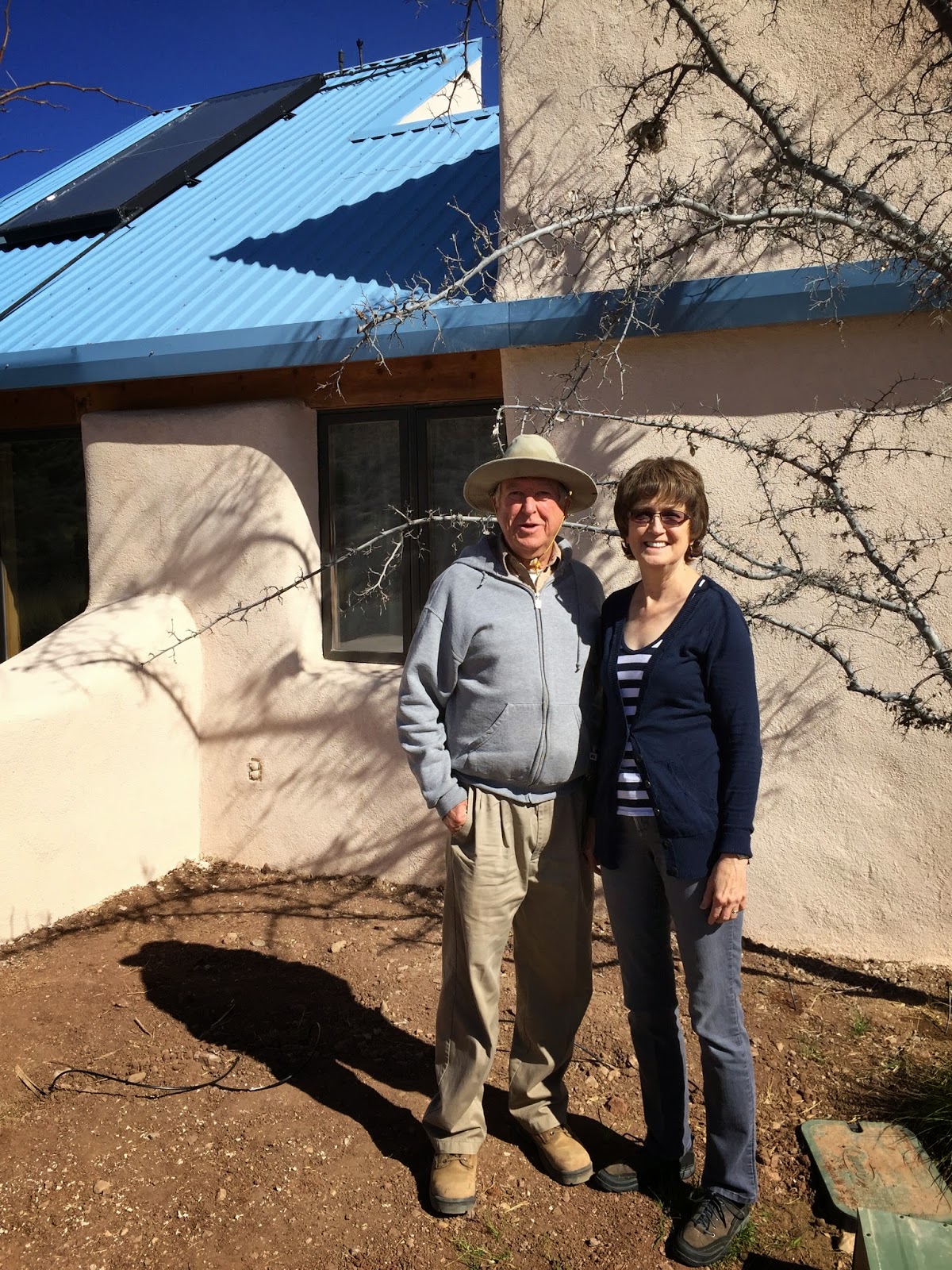
Our hosts in front of Haystack Heights, their beautiful straw bale home.
I was really pleased that a quilt I made for their house, originally thought to be a table runner, they decided to hang on the wall.


Ron wrote me this week to say the quilt is now hanging on the wall.  Always a compliment to the maker!

We spent Sunday evening watching the penultimate episode of Downton Abbey with our friends and set off the next morning for Tucson, grateful for the time away from the city and rented rooms, refreshed and ready for more great learning experiences.

It is good to start to catch up on my journey.  Next time I will share some of what I learned in Tucson.

Thanks for reading.